


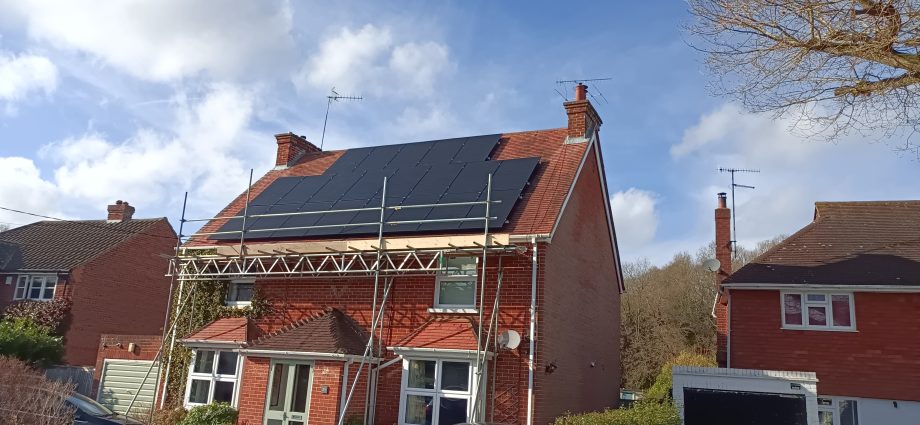
We had the front of our roof covered in solar panels together with a battery in the roof. Even on an overcast day they will supply most of our energy needs with the battery keeping us going during the night.
With electricity bills going sky high and two electric cars to charge, I have got into solar panels in a big way with both a professionally installed setup on the house and a DIY setup made up of second hand panels on my various sheds. On most days they are enough to supply all of our daytime needs drastically cutting our bills.
Solar panels have been around for the last 70 years, but it’s only really since the start of this century that we have started to see them appearing in large numbers on the roofs of houses.
They were originally expensive to install but the UK government offered some great incentives to install them which kick started the industry.
Mass production of panels in China who are both the worlds biggest manufacturer and user of panels has significantly reduced the price of solar panels making them an affordable option.
Whilst the government has now removed the incentive schemes they still make a lot of sense to install, particuarly if you expect to remain in your home for long enough to cover the costs.
How solar power works
There are two main types of solar system:
- On-grid where the solar panels connect to your homes mains supply and off-grid where there is no connection to a mains supply and the energy is stored in batteries that power devices.
- Off-grid is often used for remote buildings or motorhomes where there is no connection to a mains supply.
We will concentrate on on-grid setups in this article which are the type you are most likely to encounter.
An on-grid solar systems consist of an array of solar panels, a device called a grid tie inverter that converts the electricity supplied by the panels into a form suitable for attaching to your homes mains supply and optionally a battery that lets you store excess power so you can use it at night. Any surplus energy is fed back into the grid via your electricity meter and you are paid a small amount of money for each kilowatt hour (KWh) of energy you supply.
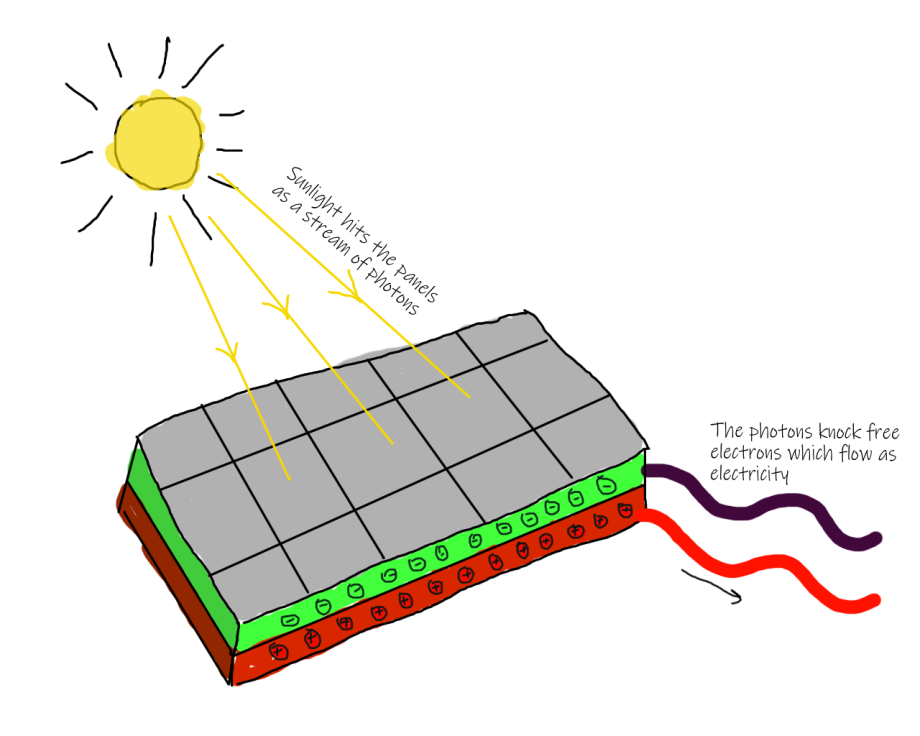
Now for the science bit! Solar works because the panels are able to take the rays of light from the sun and convert the photons of light into a flow of electrons (aka electricity). This works because a solar panel consists of two layers, one negatively charger and one positively charged. When a electron is dislodged from the panel by a photon, a corresponding ‘hole’ is created on the positive side. The electron then flows down the wires as electricity on the negative wire, does its job of work (for example powering your computer) and then returns to the panel cancelling out the hole that was created on the positive side.
The sun producers upto 1050 watts (the unit of power) per square metre of the earths surface. Solar panel cannot convert all of this into electricity and are currently around 20% efficient meaning that only 1 in 5 photons that hit the panel are turned into electricity and so each square metre of solar panels you install can supply upto 200W of power or around 1KWh of energy per day. The typical UK household uses around 12KWh of energy per day.
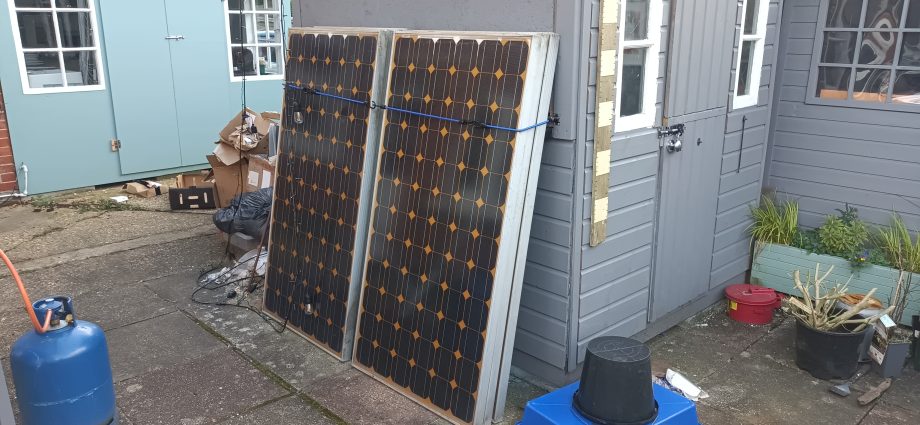
A set of second hand solar panels that I purchased from Ebay
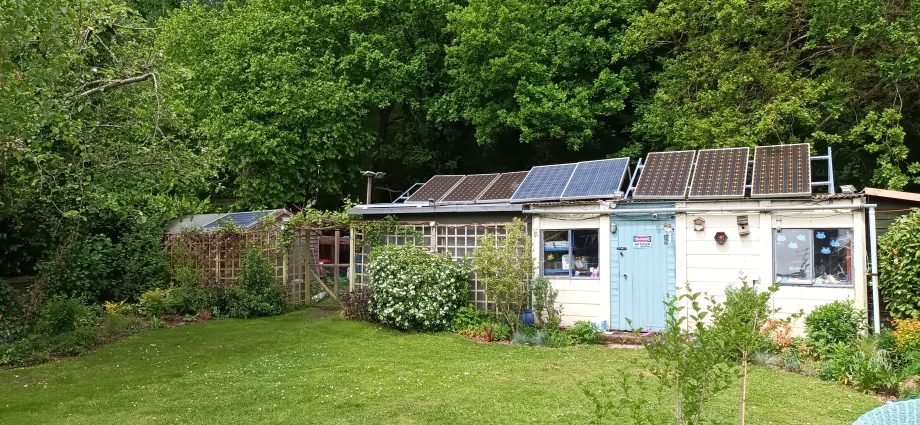
Whilst not the most aesthetically beautiful installation, I have fitted second hand solar panels to all of my various sheds. When the sun is out, these panels alone are enough to power the house.
My Setup
As mentioned in the introduction I have two solar setups at my house, one which was professionally installed and one that I built myself.
The main, professionally installed setup consists of 19 solar panels each of which can generate upto 450W of electricity when in full sun, totalling a maximum of 8,5KW in total. The panels face south-east so work at their best in the morning when the sun is facing them and start to fall of in the afternoon.
Normally we reach about 7,000W on a sunny morning, falling to around 2,000W by late afternoon and in total generate around 40-50KWh of energy. On overcast days we generate around 2,000W in the morning and 500W by late afternoon with a total generation of around 15KWh of energy.
Connected to our solar array is a 7KWh battery which charges during the day and is sufficient to get us through the night. If the battery runs flat we start to draw electricity from the grid.
For my DIY setup, we have 8 x 180W panels, 4 x 250W panels and a 400W panel totalling 2.8KWs. Some of these face south east and others south west giving us around 1.5KW->2.0KW of power on a sunny day and 500W when it is overcast. In total this adds a further 10-15KWh of energy per day to our tally.
Our house typically uses around 12KWh of energy a day rising to 70KWh when we charge our cars. With a bit of carefully planning on when we plug the cars in, and the setup supplies all of our electricity needs for 6 months of the year and about 25% of our needs during the winter months.
Whilst I have built my own DIY setup, a word of caution on taking this path. Mains electrricity is incredibly dangerous and you really should not attempt anything yourself unless you know what you are doing as it has the potential to do a lot of harm to you, others and your propery if you get it wrong. I’ve electrocuted myself twice in my life and believe me its not a lot of fun lying on the ground twitching having semi-fried yourself.
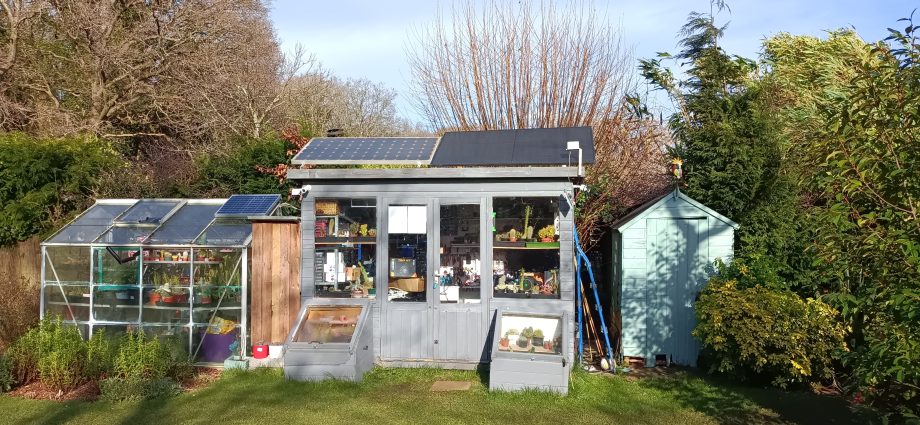
Even a smaller shed like this can generate a good amount of energy. These two panels can create a third of the homes needs when in full sun.
What does it cost?
The professional setup cost £10K of which £7K was on the solar panels and £3K on the batteries. This included all the costs for scaffolding and installation. Installation took 2 days. Smaller setups can be installed from around £5K.
For the DIY setup, I’m typically buying solar panels for £60-70 for a 200W panel via Ebay. Often you will need to pick them up as they are bulky items and not easy to post. In total for my 2.8KW setup I have spent around £1,500. This makes DIY around £570 per KW of capacity vs £823 for the professional install.
Whilst there is a reasonable saving going the DIY path, I would definitely recommend the professional install as it is a much better overall result and whilst I’m fairly comfortable with electrics, the thought of lugging heavy solar panels onto the roof of the house is definitely beyond my comfort zone. I would also highly recommend anyone looking at a solar install to invest in a battery as frequently you are generating too much or too little and the battery helps smooth this out, cover night time and avoid having to draw from the grid.
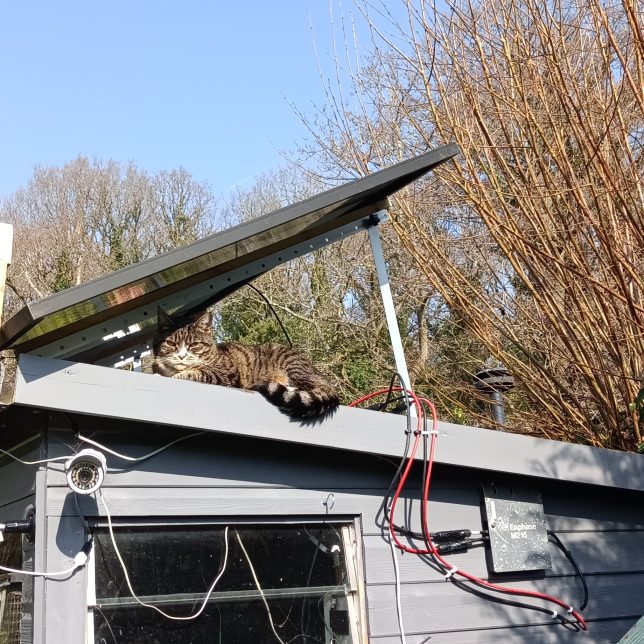
Our cat also appreciates solar, as a rather convenient warm spot to sit and contemplate her evil plans to conquer the universe.
Is it worth it?
Solar panels are an investment and it takes time for them to pay themselves off. A typical solar setup will last 20 years and with electricity prices rises in the last year, payoff can be as fast as 7 years. Due to our high energy usage due to our electric cars, we are expecting to have covered the costs within 4 years.
Other benefits include much more predictability on electricity bills and the sustainability benefits of generating sustainable electricity are considerable. In the 4 months since we have had our solar setup installed with have saved over 3 tonnes of CO2 making a significant dent in our households carbon footprint.
Another really informative post Toby. Loving the pics!
unfortunately the back of my house is north facing and, as we are in a conservation area, we can’t have solar panels at the front….so what’s your view on heat pumps/heat exchange? Worth investigating??
We may not have a choice in the future Jane as I think there a moves a foot to make all new installations ground source heat pumps.
I think heat pumps are certainly worth investigating. I think that for a lot of houses one of the main obstacles is that they require very good insulation.
This great. I thought about the route a few years back but many companies did not see reputable enough, and some were just looking for big pay days. I had researched the cost and some quotes were 50%+ higher, so unfortunately I never did it. I will be sure to look into it again. I was interested in ground source heat pumps too.
Thought more about this… Knowing that some of our warehousing is looking to install solar power. I wonder if there is the potential for a ‘buying group’ within Colart. So a company gets all our custom, but we get bigger discounts for the scale!
Great idea. Kidderminster, Minehead and Elephant in the UK are all good canidates as have roofs which are south-ish facing. Lowestoft looks like the towerblock will block the sun out for lots of the day so maybe less possible.
Thanks Toby for this passionating post and for sharing your experience with a total transparency.
Thanks for sharing this Toby and a very good deal on your professional setup. I paid almost as much for 15 panels without a battery. Is that something one could add at a later point in time as well? My panels generate quite a bit of electricity and I deliver it all back to the grid at the moment, meaning I don’t have any electricity bills at all and have the set up earned itself back after roughly 4 years as well. Can definitely recommend if you feel comfortable sleeping underneath it and have the money to invest (which over here could also be financed as part of the mortgage when I bought my own place. Not sure that can be done in the UK as well)
I’ve been thinking about this quite a bit so very informative thanks Toby, just need to work out which way our new house will be facing and make sure my wife doesn’t decide to move again negating any savings we will make 🙂