


 Download PDF
Partnership with Insideart and MACRO Museum of Contemporary Art of Rome
In 2018, the international Italian art and culture magazine, Insideart approached Colart to collaborate on a project led by Macro Museum Curator Giorgio de Finis, who wanted to transform the museum into a “living organism” by inviting artists to populate the space through one-week residencies. The rolling program, which comes to an end in 2019 is known as Macro Asilo and is part of a series of activities, performances and talks aimed at attracting visitors to this museum in Salario, north east of Rome. Insideart created a group of interviews focusing on artists’ relationship to materiality who were then invited by Giorgio de Finis to come on board his ingenious project to bring the museum alive.
7 artists, from Italy and abroad, had been selected for the Macro Asilo residency programme that involves the TFAC teams and Liquitex, Winsor & Newton and Lefranc Bourgeois brands. The programme focusses on how matter and colour are used in contemporary art. A narrow portion of time (one week) and space (an Atelier in Macro Asilo) for the artists to shed lights on different personal interpretations of painting.
What does Macro Asilo look like?
Upon arrival at Macro (built in a former Peroni brewery and recently expanded by the leading French architect Odile Decq), one is greeted with a strong sense of modernism and futuristic design. The glass exterior contains within the internal architecture; a bold (cadmium red and matt black) extravaganza which holds exhibition spaces and has at its centre a dramatic space-age auditorium where talks and lectures are held. This is in contrast to the residential and working area the museum is located in, creating a sense of another time and space when entering this heterotopia.
Residencies on stage
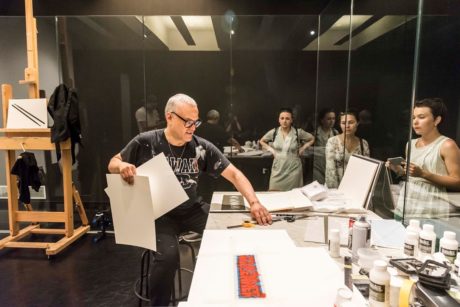
For a residency an Atelier is provided, (one of four studios inhabited by artists). Artist residencies tend to be periods which offer artists self-reflection and introspection, but the nature of this one-week residency meant that it was ‘go’ from the start. Designed for the benefit of visitors, the large studios contain within them a raised platform stage surrounded by three glass walls, which allow the viewer to see the artist at work and engage in conversation about the work being made.
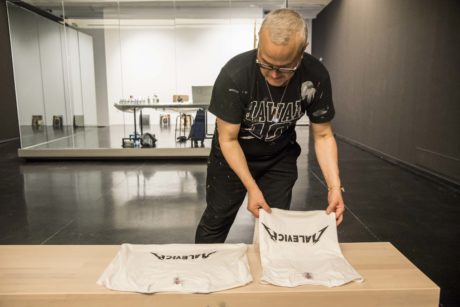
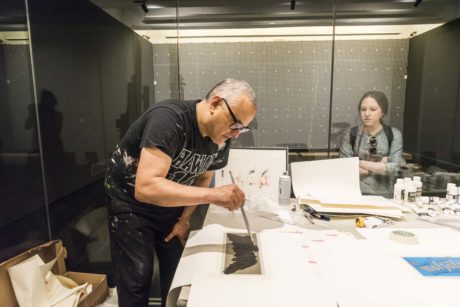
Juan Bolivar on residence
Juan, a London-based artist and TFAC UK lecturer, participated in the one-week residency programme in late July.
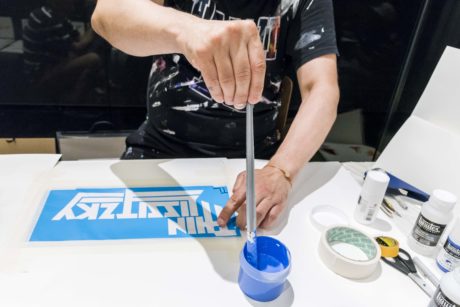
The work made by Juan Bolivar during his week consisted of creating a series of t-shirts (using Liquitex acrylic paint and mediums) merging the names of Bauhaus artists and rock band names.
In September 2019, the t-shirts will be worn at the Bauhaus 100 Festival in Dessau, Germany by students from Camberwell College of Arts (London) where Juan is a lecturer in Painting.
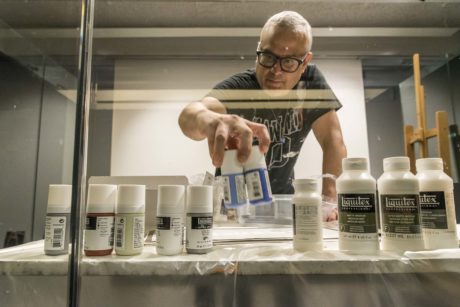
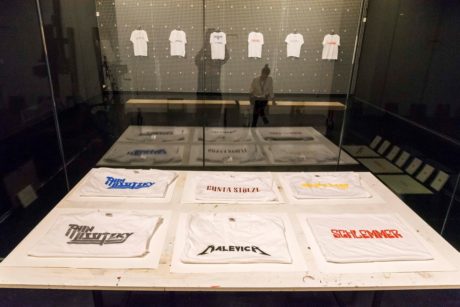
Watch a short film of Juan presenting his work:
For example Albers (as in Josef and Annie), would appear in the font of the Australian rock band AC DC. The artists he chose belong to the Bauhaus school (with the exception of Malevich), some of them well known (such as Albers), and some more obscure (like Gunta Stölzl the only female Master at the Bauhaus). Likewise, some band names will be better known and some more obscure.
So whilst most people might recognise the AC DC or Motorhead logos, fewer (and only the more discerning rock enthusiast) will recognise Scorpions or Thin Lizzy. Thus the response from the public was divided into four groups:
- those who recognised the artists and band names,
- those who recognised only the artists names,
- those who recognised the band names, and
- those who recognised neither.
Watch what work Juan and the other artists created during this one-week residency:
Using Liquitex mediums
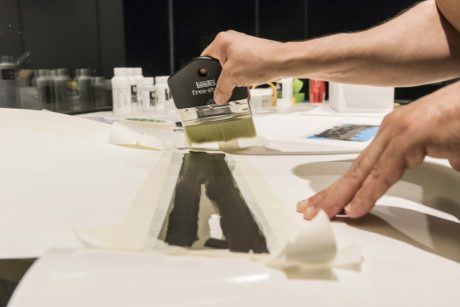
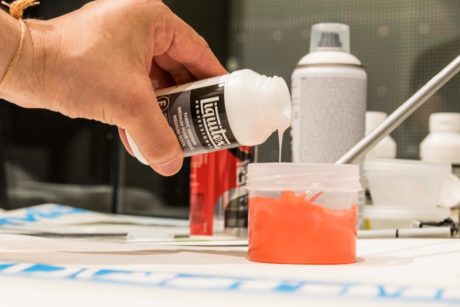
The residency was a chance to test what Liquitex mediums worked best with Soft Body and Heavy Body acrylic for the purposes of these t-shirts and works on paper. Not surprisingly, Liquitex’s Fabric Medium worked the best for t-shirts; allowing the Soft Body acrylic to soak into the fabric creating an even flexible paint film.
Some of the other mediums were also used to modify the mattness of the paint finish (Matt Medium and Ultra Matt Medium), and improve the flow and evenness of the colour (Flow Aid).
A great experience
Rome is a wonderful city with great art and culture. The residencies were an amazing opportunity to make new bodies of work, to meet and engage with the public; answering questions about both the content of the work and the techniques and materials employed, whilst gaining valuable feedback about their reading of the works made.
Other Macro residencies will be shared on Colart news in the future.
Later in November, Insideart will hold an exhibition at Fondamenta and present works from all the artists who have participated at Macro Asilo.