


 Download PDF
What is the ‘liquitex white walls’ project?
Liquitex white walls is a great example of how TFAC directs traffic to brand. Each year we create a white walls project either through funded partnerships or through open submissions to engage with leading art schools, this time as Cental Saint Martin’s and Camberwell.
Highight on: Mateo Gabayet’s project
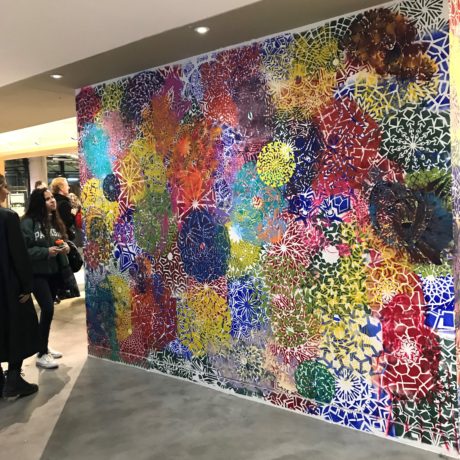
Mateo is a BA Fine Art student. Influenced by the Mexican muralist movement, Mateo Gabayet created a mural using a diverse and vibrant palette of visual abstractions which covers different formats and themes. These geometric patterns consist of multiple layers of overlapping shapes and mediums, giving audiences endless perspectives in a sea of colour.
Inspired by electronic music and techno, Gabayet’s piece depicts a visual rhythm with its repetition and looping shapes
What prompted you to apply for this project in first place? Do you normally work in this context and scale?
My tutor Juan Bolivar suggested on creating a small portfolio of mural painting in preparation for the project, having done these practices I became really confident with big formats. My formal mural works started six months ago when I arrived in London, since then I have done exactly 7 pieces.
When you applied for the Big white walls project where did your ideas stem from?
My work reflects completely the context of my past. I draw inspiration form electronic music, I paint the way I would Dj for a crowd, I have a library of songs/stencils and I arrange them in a way they can blend and interact with each other. Creating a festive landscape of rhythm with repetition and energy with colour.
Were you influenced by any artists who have worked in this context before?
Yes, Mexican pre-Colombian motif combined with my visual projection of electronic music consist the graphic inspiration. Influenced by the op movement converged with the Mexican muralist movement.
Lately I have been researching the ‘Gesamkunstwerk’ (total artwork) which aims to combine diverse mediums to create a multi-sensory work, and an all embracing art genre.
How did your ideas evolve? Has your idea changed at all?
Looking back, I think the most evolution has been my choice of material. At first this work was meant to be carried on exclusively with spray paint acrylic, nevertheless my use of aerosols was restricted to small amounts for health and safety reasons. Given the situation it was compulsory to find alternatives, I found soft and heavy acrylics to be a great alternative to create different textures.
How did you find the materials and mediums created by Liquitex, and how did this inform or impact your work?
Modelling paste proved to be an amazing choice to add volume and texture to any piece, I intend to continue adding these accents to my work in the future. Soft body acrylic by Liquitex has become the main support for the work I do for clothing as well as the conventional paintings.
What were the most useful aspects of the support you received?
Definitely I could not have arrived at this plastic conclusion by myself, Stephanie Nebbia and Juan Bolivar are to credit for their indispensable teachings.
I am also surprised and delighted with the social media exposure carried out by numerous sources.
What was the most valuable part of this experience?
What I value the most is the knowledge attained from all the encouragement to explore the different possibilities in terms of medium. The installation was a great experience which boosted my moral by giving feeling of approval from the college.
What do you hope to do next?
I am now seduced by the idea of how a big format piece would materialize if made only with modelling paste. I also want to explore further plastic possibilities employing screen and lino printing without disregarding what I have learned recently of course.
Highlight on: Lewis Buttery’s project
Lewis’ idea evolved through the tests and studies beforehand where he stated “I am glad I didn’t play it safe and just stay with the original ideas.”
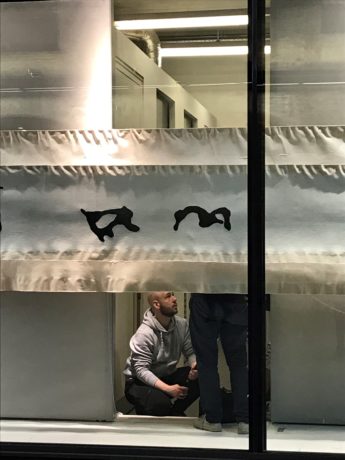
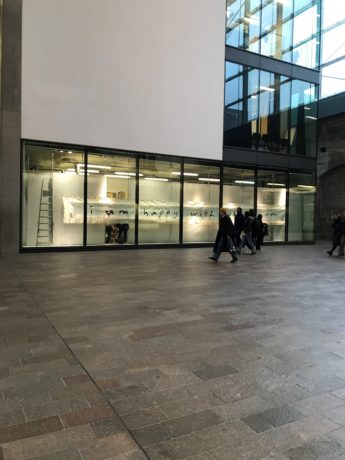
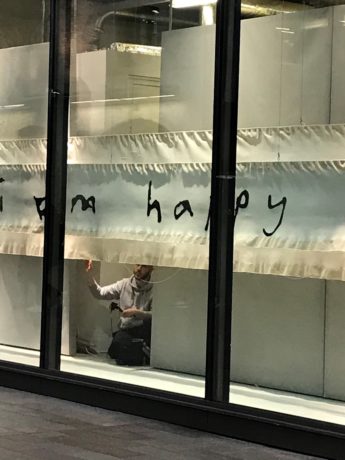
Lewis explains he had initially proposed to create the text using stencils and spray paint but following his experiments with mediums became interested in exploring form and text using a range of applications. This culminated in drawing the letter forms with pouring medium and paint, having examined different consistencies. This enabled him to develop a loose gestural approach to mark making which generated letters that worked independently also as forms.
Lewis used texture gel to develop the markmaking in the second layer of the piece so that the whites were differentiated also by physical space as well as the application used to create these expanses of surface.
All this led to creating a platform for these powerful statements which sit like raised gestures across the canvas like a concrete poetry.
What prompted you to apply for this project in first place? Do you normally work in this context and scale?
It was a combination of things that prompted me to apply for this project. It was the opportunity to get my work on the radar of anybody going into CSM. It was the opportunity to work at this scale, but not have to worry about the materials costs. I don’t normally work at this scale because of these costs and I do normally work in the context of the inky text based affirmations.
When you applied for the Big White Walls project where did your ideas stem from?
When I applied, my ideas stemmed from previous similar smaller-scale installations that I showed in window displays in Hackney and Peckham. I wanted to see how the work is recontextualised by being shown at CSM.
Were you influenced by any artists who have worked in this context before?
I was influenced by Ed Rushca, who’s worked in the context of text based work with painting before.
How did your ideas evolve? Has your idea changed at all?
My ideas evolved from planning on using a projector to blow up my a5 sketches to a massive scale, cutting out a stencil and spray painting it. It’d have kept the shape of the text the same, because when I’m doing the sketches it’s with ink. I was trying to keep that effect on the text the same and it was suggested that I use acrylic paint mixed with a pouring medium, which has ended up creating a very similar effect.
How did you find the materials and mediums created by Liquitex, and how did this inform or impact your work?
I found the materials and mediums created by Liquitex versatile/flexible, which informed my work because I was able to mix all of their products together. For the textured canvases behind the text, I ended up extending my white acrylics by adding left over gesso, then thickening it with Liquithick and modelling paste.
What were the most useful aspects of the support you received?
The most useful aspects of the support I received were the availability of it when the pressure was on and the access to knowledge about things I could do with the materials.
What was the most valuable part of this experience?
The most valuable part of this experience was learning that I can still have a dialogue with a work that I’ve written a proposal for; I don’t have to put pressure on myself to make it exactly like I said I would. It was also networking, it was promotion, it looks good on my artist CV, but I got the experience of delivering my first private view speech as well.
What do you hope to do next?
Next, I’m hoping to apply my ideas of spreading positivity to the figurative painting part of my practice. I’m planning on looking into how I might do that through my use of colour, subject matter and mark making.